Most lost revenue in commercial landscaping doesn't come from losing a bid. It comes from work that was never proposed, renewals that arrived as a surprise, margin that bled a few hours at a time, and field issues that lived in a visit note nobody reread.
The frustrating part is that the evidence was in Aspire the whole time. Buying patterns, proposal history, visit notes, labor hours, contract margins — it's all there. But an account manager running dozens of properties doesn't have time to reread every visit note and re-run every margin report weekly. So the question that actually decides the year — across everything I own, what deserves my attention this week? — mostly gets answered by whoever called last.
Capsa users answer it differently. Capsa's AI reads the whole book of business and turns what it finds into a prioritized list of recommended actions — each one explained, each one assigned to a person. Here's what that looks like in practice.
1. The cross-sell nobody had time to spot
Capsa noticed that a property buys mulch and bed prep every year — and that no matching proposal existed for this year. It drafted the task and showed its math: prior-year purchases point to a $6,880 estimated opportunity, with no current proposal to capture it.
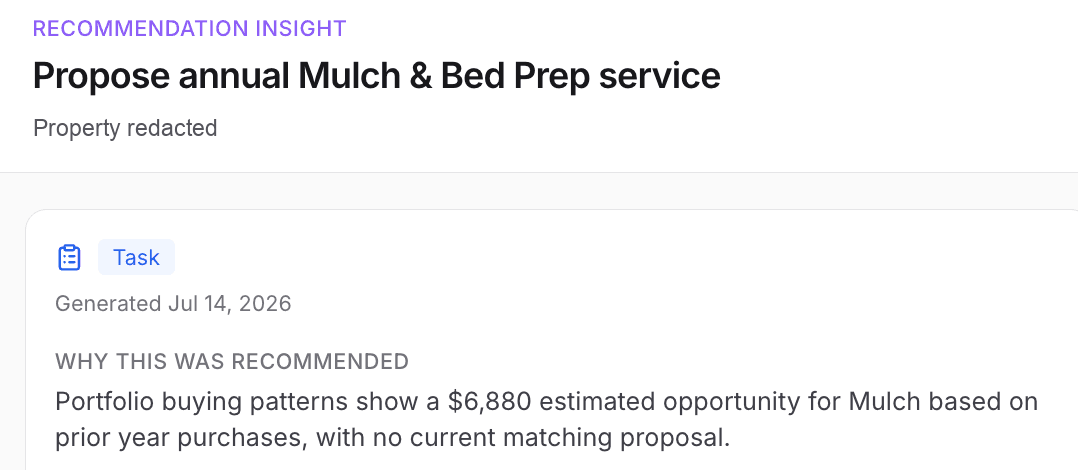
No one had to remember what this property bought last April. The pattern was in the purchase history; Capsa surfaced it while there was still time to sell the work.
2. The right task before the right visit
At another property, Capsa connected four facts no one had put side by side: enhancement penetration was 0.8%, only one proposal had gone out in 305 days, that proposal closed — a 100% close rate that suggests the team was only proposing reactive work — and the contract renews December 31.
Its recommendation: use the site visit already on the calendar to scope aesthetic enhancements and safety repairs, and build a proactive pipeline before the renewal conversation. It arrived as a high-priority site inspection task, assigned to a specific account manager.
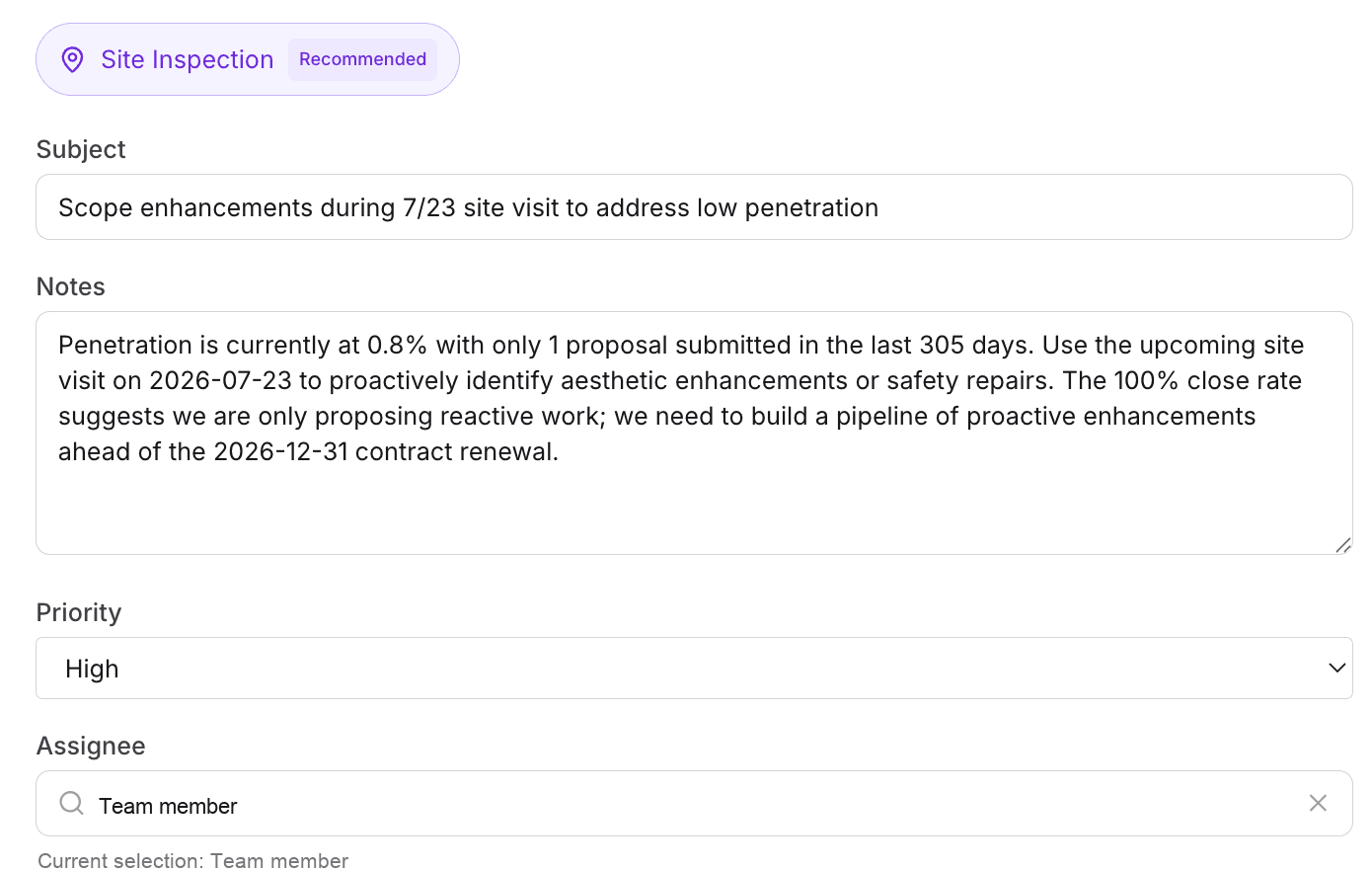
That's the difference between “we should propose more enhancements” as a slogan and as a Tuesday.
3. The visit note that refused to be forgotten
A technician noted leaks and dead zones in an irrigation system that can't be repaired until the client's construction wraps up. Normally that's exactly the kind of issue that vanishes — real, valid, and easy to forget because nothing can happen yet.
Capsa holds it as an open action with a running summary of the whole history — the system has been partially down since an April turn-on — and one-click paths to create a task, open an issue, or mark it resolved.
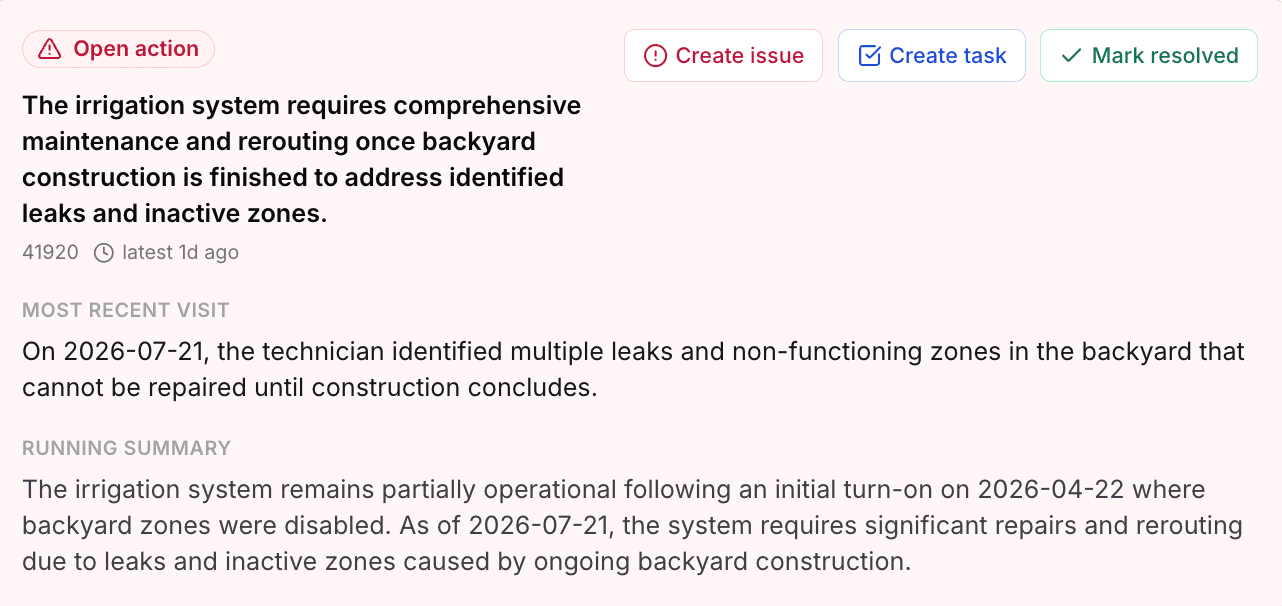
The follow-up work — and the repair revenue that comes with it — stays visible until someone closes it on purpose.
4. The margin leak measured in hours
A weekly mowing route was quietly running long: the most recent visit took 10.9 hours against a 7.9-hour benchmark built from faster comparable work, and the recent average sat at 9.6. Any single visit is noise. Capsa annualized the gap, framed it as a recurring-service efficiency review, and put the exact numbers to check in the task itself.
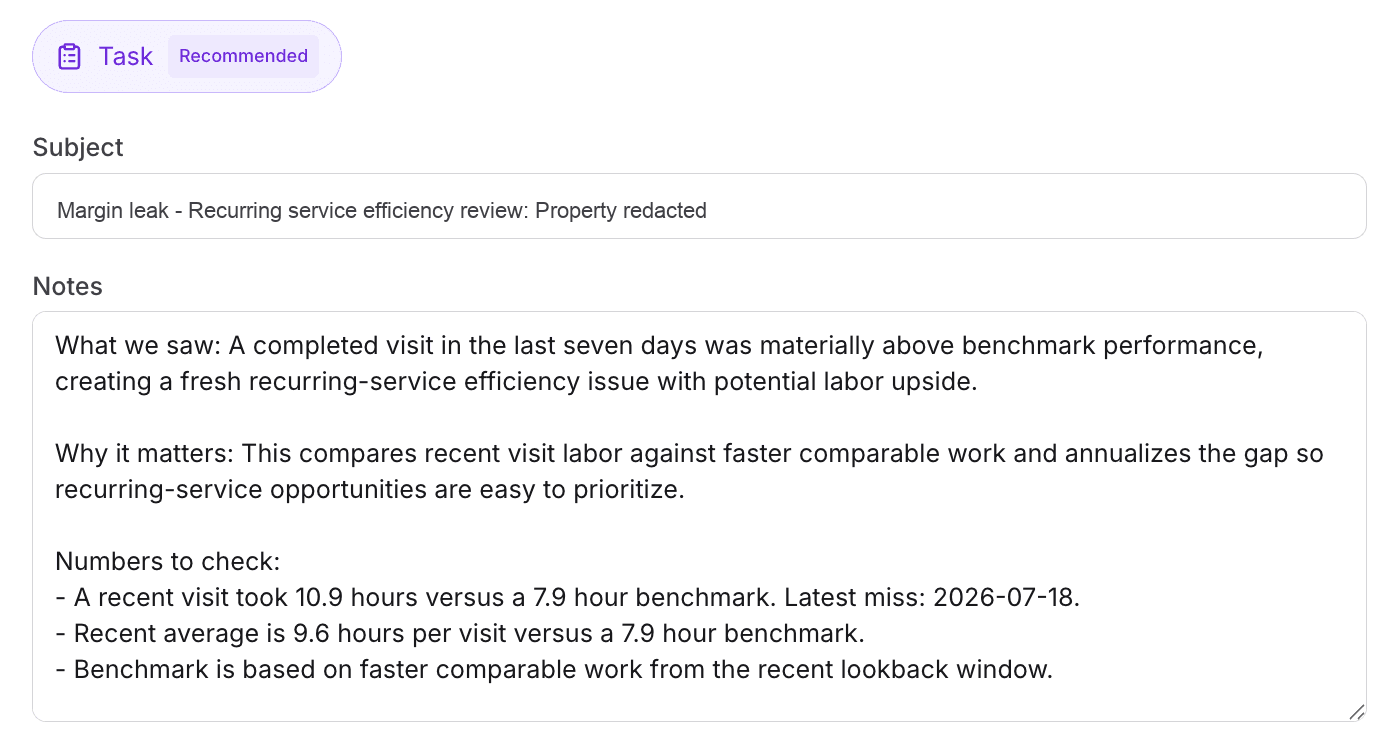
Nobody pulled a labor report to find this. It surfaced because the gap was worth money.
5. A renewal plan for every property — not the same plan for every property
Renewal season is where prioritization matters most, and where a flat “raise everyone 4%” quietly leaves money — or relationships — on the table. Capsa drafts a renewal plan per property, with the economics written out. Three properties, three different answers:
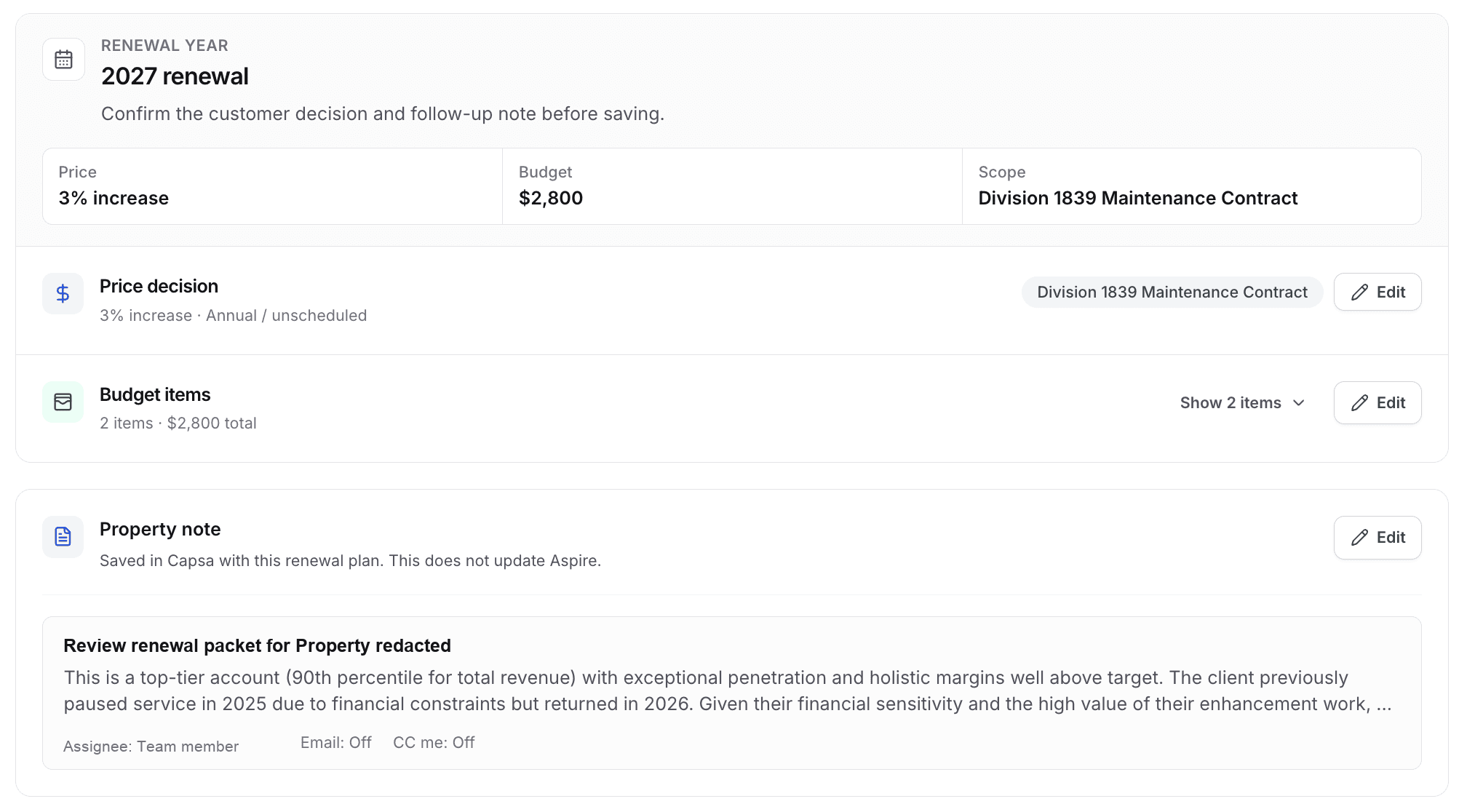
A top-tier account with margins above target — 90th percentile in total revenue — that paused service in 2025 over money and came back in 2026. Recommended: 3%, a measured increase for a financially sensitive, high-value relationship.
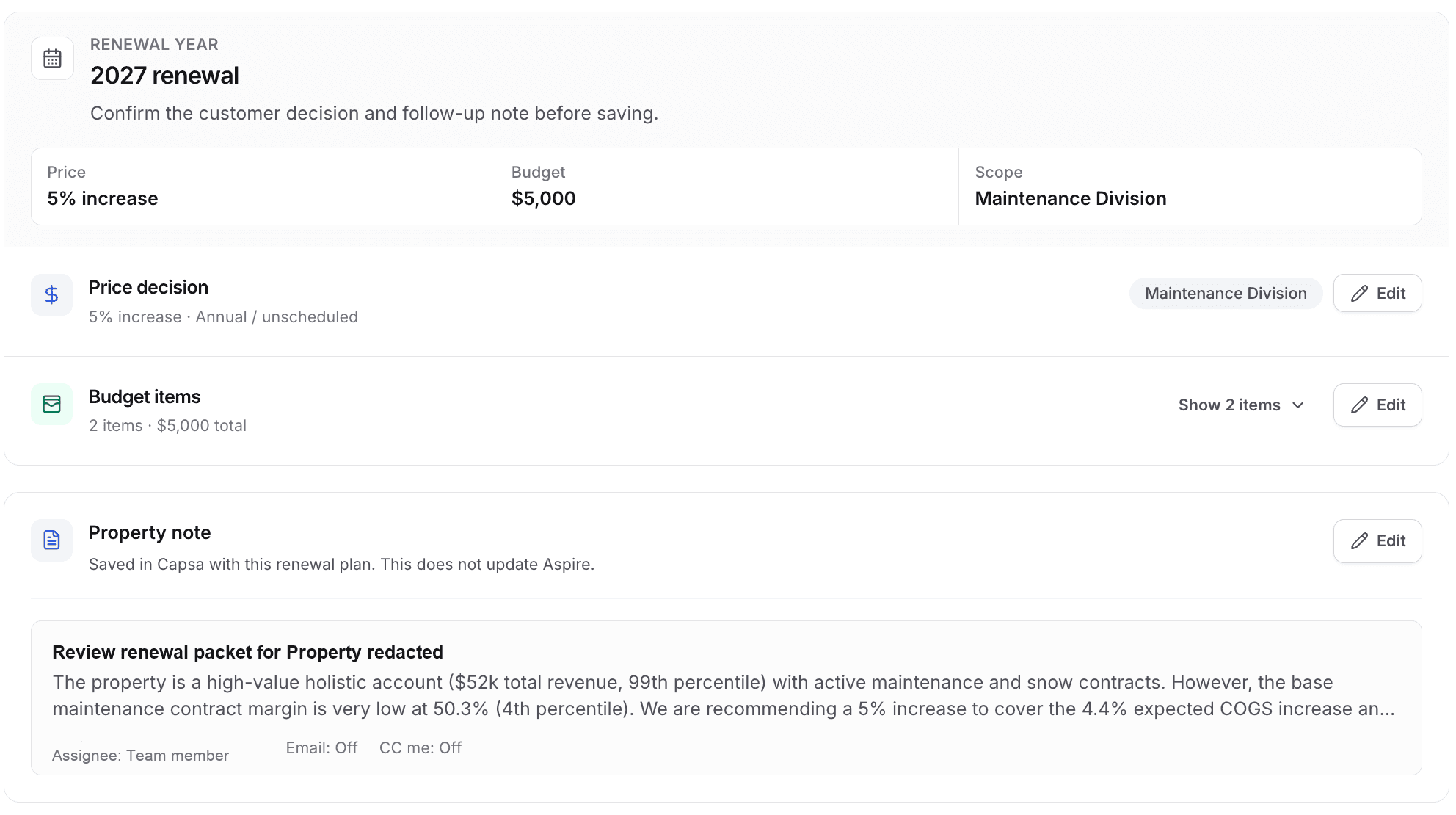
A high-revenue account with a thin base contract — 99th percentile in revenue, but the maintenance contract margin sits at the 4th percentile. Recommended: 5%, sized to cover a 4.4% expected cost increase.
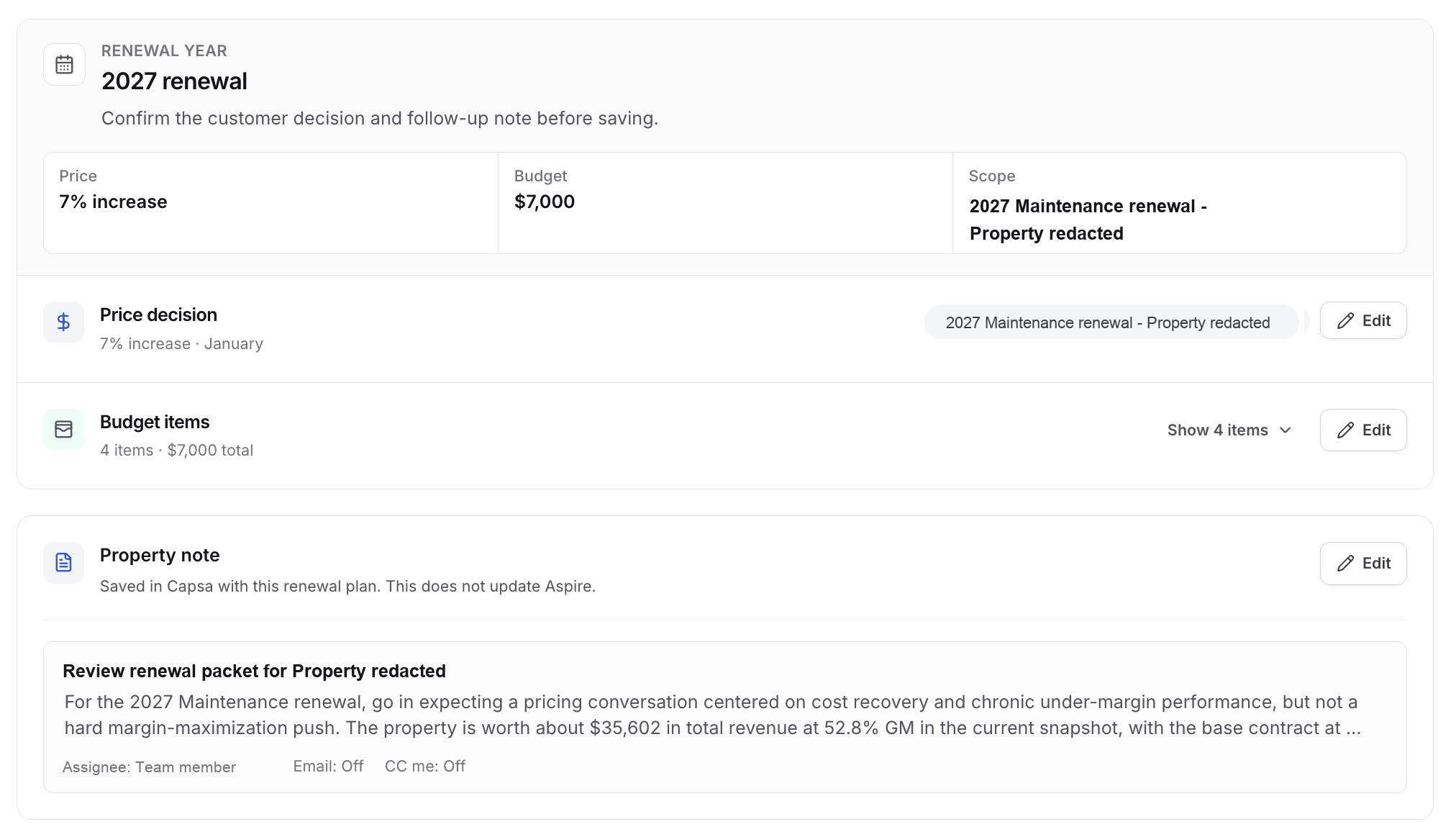
A chronically under-margin property. Recommended: 7% in January, with coaching to frame the conversation around cost recovery rather than a hard margin push.
Each plan comes with reasoning an account manager can read, edit, and defend in front of the client. And none of it saves without a person confirming the decision.
The pattern: AI drafts, people decide
Every example above works the same way:
- Capsa reads what nobody has time to read — purchase history, proposal activity, visit notes, labor hours, contract economics — across every property.
- It ranks what it finds by dollars and timing, so the list starts with what matters most.
- It shows its reasoning — why this was recommended, the numbers to check, the history behind the flag.
- It hands a person a drafted action — a task with an assignee, an issue, a renewal plan awaiting confirmation. The judgment calls stay human.
That's the leverage. Not fewer account managers — the same account managers, finally working from the top of the list instead of the top of the inbox.
One check worth running this week
Pull your ten biggest maintenance accounts and ask two questions: When did each one last receive a proactive proposal? Who is watching its renewal economics right now? If the honest answer for some of them is “nobody, currently,” that's not a people problem. It's exactly the reading-and-ranking work AI should be doing for your team.
Screenshots are from Capsa's demonstration environment. The underlying data is real and has been anonymized; property and team member names have been redacted.
See the gaps your team is missing
Capsa gives landscape company leaders full visibility into proposal activity, coverage gaps, and ancillary capture rates across every property.